The emergence of wave soldering technologies represented a huge step forward in the world of PCB manufacturing. Deployed with the right expertise and knowledge, wave soldering consistently delivers impressive results in terms of throughput, performance and the consistent quality demanded by high-reliability applications such as aerospace.
Wave soldering also allowed assemblies to become progressively more compact. Sometimes though, wave soldering isn’t the best or entire answer for particular PCB assemblies. Examples include:
-
- Assemblies with tall components that can block the solder wave.
-
- Where a combination of surface mount and through-hole componentry is the optimum solution.
-
- Assemblies that use sensitive and high value components that could be affected by the high temperatures used in wave soldering.
-
- Low-volume and prototype assemblies.
Selective Soldering – the Basics
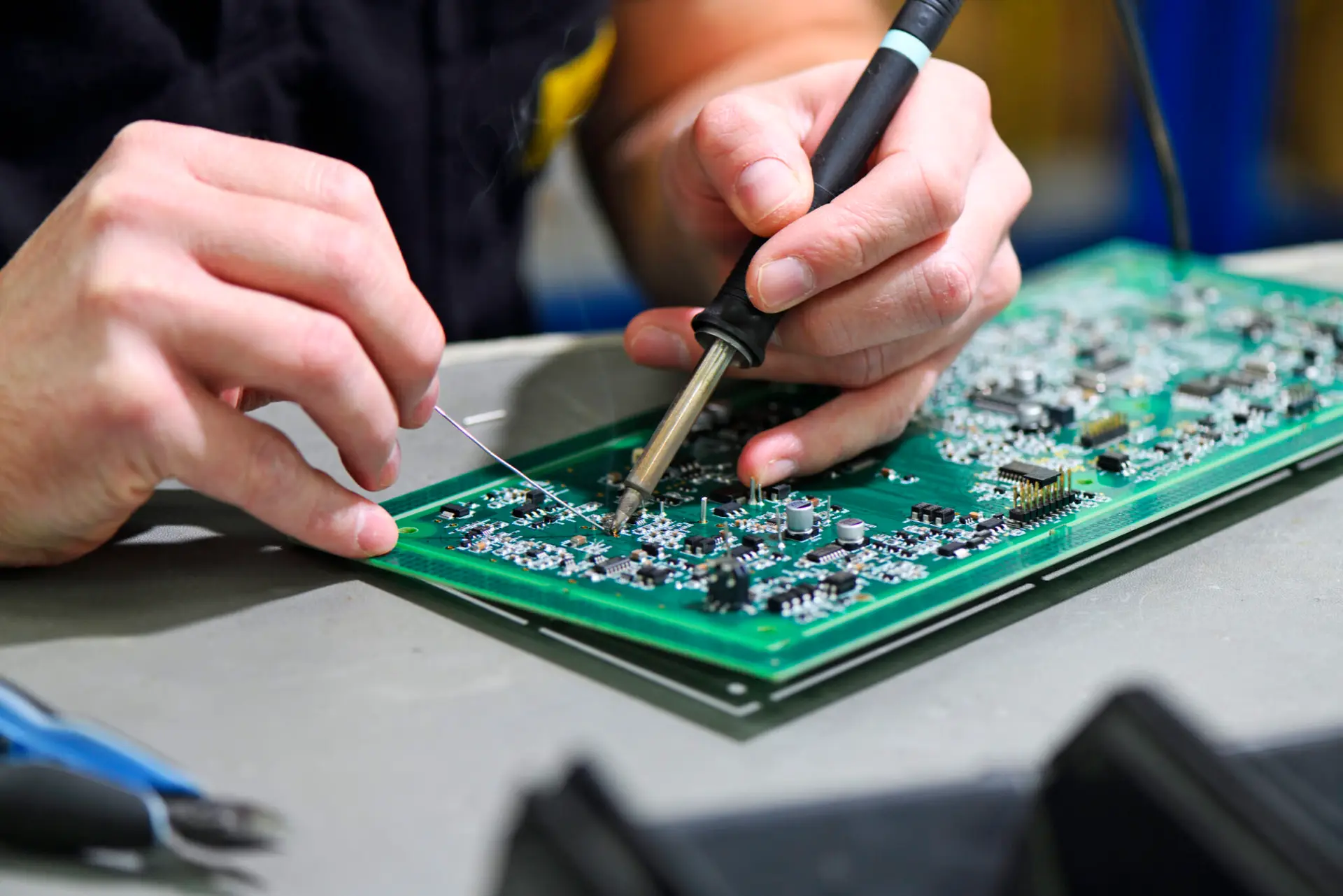
In these situations selective soldering is often the best solution. This technology uses precision application of solder through a programmable soldering head that directs a small solder fountain to specific parts of the board to connect through-hole components.
Selective soldering offers precise control over individual solder joints for a clean, consistent and highly reliable end result. It’s a faster and more consistent option than hand soldering and can cope with more tightly-packed components.
Additionally, with Trizo’s investment in a second soldering machine, capacity has been increased, enabling faster turnaround times for customers. These machines are now operating full-time, allowing us to meet the growing demand while maintaining excellent quality and precision. This increase in capacity is great news for both us and our clients, ensuring improved speed and efficiency in our production processes.
Selective Soldering Trade-Offs
The trade-offs with selective soldering compared to wave soldering include lower throughput, higher unit cost and a longer set-up time needed to program the selective soldering machine. The time penalty is partly offset using modern point and click programming tools and the fact that there’s no need to apply protective masks to areas of the board that might be affected by contact with the solder.
The Optimum Manufacturing Solution
As is usually the case with PCB manufacturing the ideal choice of method depends on multiple technological and economic factors, which makes the experience and range of solutions available from the PCB manufacturer critical.
Careful design and a thorough DfM review will lead to the optimum manufacturing solution in terms of productivity, quality and long-term performance of the finished assembly.
Interested in learning more about modern electronics manufacturing for high reliability markets?