
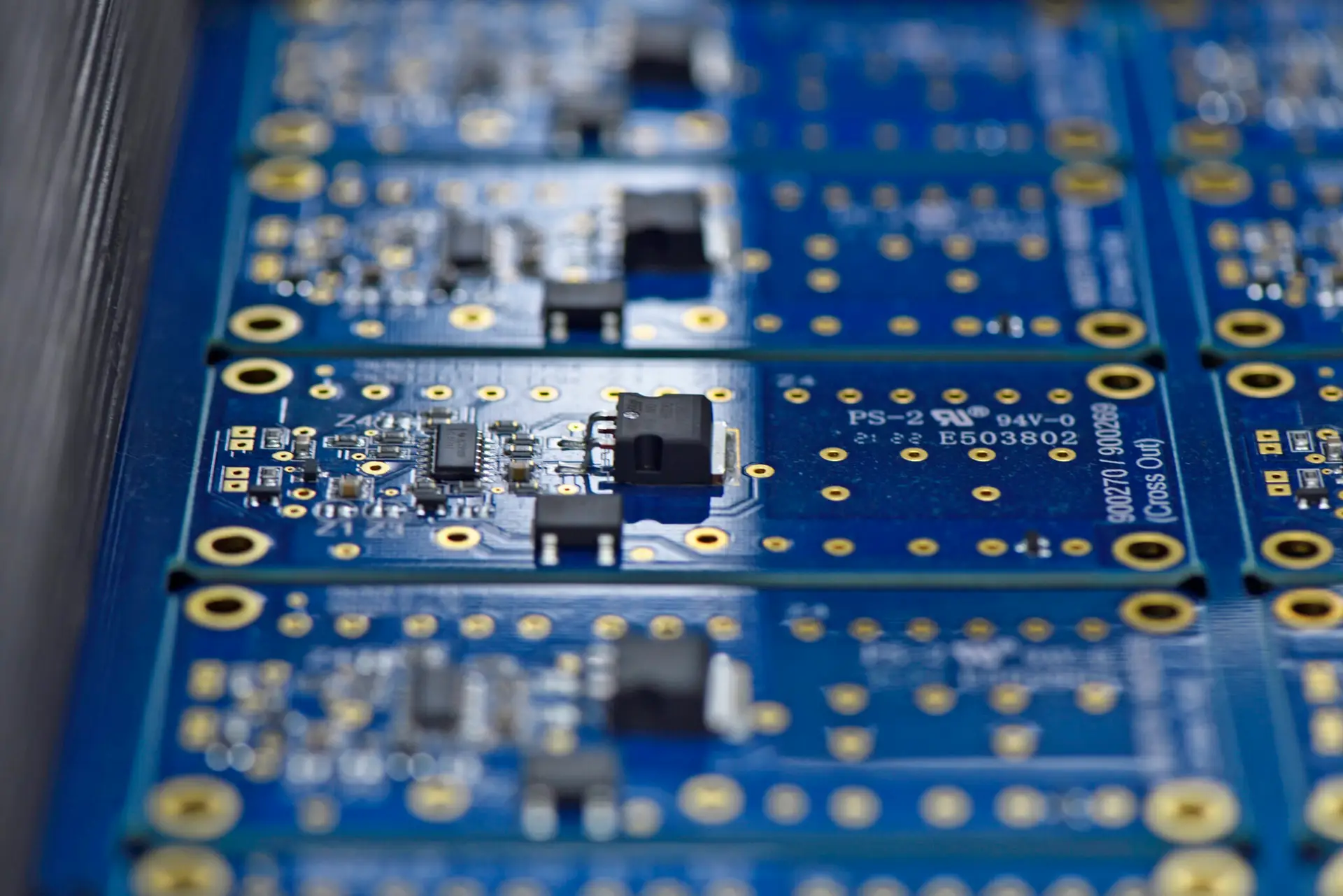
Surface-mount technology (SMT) sits at the heart of modern electronic manufacturing.
By placing components directly onto the PCB surface, manufacturers achieve higher density, faster throughput, and improved performance. Shorter signal paths reduce noise and support higher operating frequencies. As a result, SMT delivers greater reliability across commercial, automotive, medical, and aerospace applications.
Design for SMT & PCB Manufacturing
Strong Design for Manufacturing and Assembly (DFMA) underpins efficient SMT production. Consistent polarity, clear pin orientation, and accessible test points speed up assembly and simplify inspection.
In addition, good design practices reduce cost and support scalable PCB manufacturing and contract electronics manufacturing services.
High-Speed Pick-and-Place Performance
Throughput depends heavily on the pick-and-place platform. Trizo’s S20 Hybrid Modular Mounter achieves speeds of up to 45,000 components per hour (CPH). This capability supports high-volume SMT assembly with precise component placement.
Built-in component testing checks passive values and diode polarity before placement. Consequently, incorrect or out-of-spec components never enter production.
AOI & X-Ray Inspection
Advanced SMT manufacturing relies on robust inspection. Automated Optical Inspection (AOI) quickly identifies visible defects. Meanwhile, high-resolution Automated X-ray Inspection (AXI) detects hidden issues such as voids or internal solder cracks.
These capabilities are essential for high-reliability sectors like medical electronics and aerospace manufacturing. Not all defects appear on the surface, and smaller SMT solder joints make minor flaws more significant. Therefore, Trizo’s investment in next-generation offline AXI supports true zero-defect production.
Soldering and Reflow Control
Solder paste requires careful handling, and precise printing prevents shorts and weak joints. At the same time, environmental control plays a critical role.
Trizo’s Parker nitrogen generator delivers 99.995% purity nitrogen. As a result, the SMT process remains clean and free from oxidation.
Reflow parameters such as temperature, soak time, conveyor speed, and atmosphere must remain tightly controlled. This ensures consistent joints and minimises thermal stress across all contract electronics manufacturing workflows.
Reflow Oven Temperature Control
For high-precision applications, accurate control of the reflow temperature profile is essential. Heating and cooling rates, conveyor speed, and atmosphere must work together to create optimal soldering conditions.
During pre-heating, solvents in the solder paste evaporate gradually. This reduces thermal stress and prevents paste collapse that could cause short circuits.
Next, uniform heating minimises temperature differences across the PCB. This prevents issues such as component lifting and ensures effective wetting by molten solder.
Finally, controlled soak time allows the flux to clean the soldering surfaces thoroughly without burning off too early.
Data Management and Traceability
As an AS9100-accredited electronics manufacturer, Trizo places total component traceability at the centre of its operations. Every component is tracked from supplier and batch information through to its exact placement on each PCB.
This visibility is vital in high-reliability manufacturing. When testing identifies anomalies, traceability enables rapid investigation and corrective action. For aerospace, medical, and automotive programmes, traceability becomes an essential data management discipline.
Benefits of Component Traceability
Comprehensive traceability strengthens quality control at every stage of SMT assembly and PCB manufacturing. It allows manufacturers to:
- Isolate potential defects before they escalate
- Maintain consistency across production runs
- Support advanced diagnostics and failure analysis
- Strengthen supply-chain resilience
In addition, traceability improves procurement efficiency. It helps remove bottlenecks, optimise inventory levels, and streamline supply-chain management.
Anti-Counterfeiting Controls
Counterfeit electronic components remain a serious risk. Even major organisations, including NASA, have experienced the consequences.
High-reliability markets demand full authenticity documentation throughout the supply chain. For aerospace, medical, and automotive customers, the ability to verify the origin and history of every component is essential. That assurance begins with the manufacturer and extends through trusted supply-chain partners.
Data Analytics And Process Monitoring
High-volume SMT production generates large amounts of data. Automated test data logging, linked to traceability systems, provides complete process visibility.
Manufacturers can then apply data analytics, statistical process control, and real-time monitoring. These tools reveal performance trends and highlight opportunities for improvement.
Key performance indicators include defect rates, cycle times, and equipment downtime. With dynamic monitoring, teams can make informed decisions and improve efficiency.
High-Reliability SMT Assembly
SMT is not only about compact PCB design. It also accelerates production and supports consistent quality.
By combining lean processes, automation, advanced inspection, and strict environmental control, Trizo delivers high-precision SMT assembly and PCB manufacturing for demanding industries.
High-Reliability Versus Commercial Electronics
Modern commercial electronics are far more reliable than they were decades ago. Automated manufacturing, statistical process control, and end-of-line testing now drive continuous improvement.
However, a significant gap remains between consumer expectations and the requirements of high-reliability sectors. Aerospace, medical, nuclear, and automotive applications demand much higher standards.
Aerospace Electronics Assemblies
Aerospace systems highlight why reliability requirements vary so widely. A consumer device may last a few years, while a satellite subsystem must perform flawlessly for decades.
Aerospace manufacturing demands strict process control, full traceability and extensive inspection. Many assemblies also require conformal coating and environmental screening. Each serialised unit undergoes testing before, during, and after stress exposure.
For low-volume production runs, even a single failure may be unacceptable. As a result, aerospace relies on rigorous contract electronics manufacturing with uncompromising quality assurance.
Medical Electronics Manufacturing
Medical electronics production follows ISO 13485, which closely aligns with AS9100. Both standards emphasise controlled supply chains, process validation, risk management, and traceability.
In medical applications, high-reliability PCB manufacturing and comprehensive testing protect patient safety. While the context differs from aerospace, the principles remain the same.
Automotive Electronic Assemblies
Automotive electronics combine higher volumes with harsh operating environments. Systems face varying thermal, vibration, and mechanical stresses depending on their location in the vehicle.
Despite larger production runs, automotive electronics remain safety-critical. Manufacturers must combine robust SMT assembly, proven design practices, and strict functional testing to meet these demands.
Designing Reliability from the Start
High-reliability electronics must be engineered for durability from the outset. This includes component selection, PCB thickness, land pattern design, and effective heat dissipation.
Assemblies must also use quality-assured, fully traceable materials. Rigorous testing then validates performance across aerospace, medical, nuclear, and automotive applications.
From PCB manufacturing to contract electronics assembly, the goal remains constant: uncompromising reliability throughout the product’s service life.
Zero Non-Conformances: Trizo Passes AS9100 Audit with flying colours.
Trizo has successfully passed its latest AS9100 audit with BSI, achieving a clean result with no non-conformances. This outcome reflects the dedication of the entire team and reinforces Trizo’sposition as a trusted provider of advanced electronic assembly and manufacturing for high-reliability and mission-critical sectors, including aerospace, medical, automotive and nuclear.
“We moved our Quality Standard last year to BSI and they have been really helpful with this transition. AS9100 keeps Trizo focused on delivering quality to our customers. It is a challenge to ensure that processes are followed alongside OTD, but a great team helped us achieve these solid results.”
— Liz Robson, Operations Director
Achieving a clean audit is a significant milestone for any electronics manufacturer operating in high-reliability markets. The AS9100 assessment reviews every aspect of the business—from supply-chain control and component authenticity to production traceability, data management and process consistency across PCB manufacturing, SMT assembly, and wider contract electronics manufacturing services.
Passing with no NCRs demonstrates Trizo’s culture of continuous improvement and its commitment to delivering fully traceable, compliant and high-performance assemblies. It ensures customers across aerospace, medical, automotive and nuclear applications benefit from the highest global standards in PCB electronic manufacturing, quality assurance and long-term reliability.